Medical and dental students often ask whether the Honhaar Scholarship Phase 4 programme covers their long and demanding courses, and what marks, domicile and income rules apply to them. The short answer is that MBBS and BDS students in public medical and dental colleges can be covered, provided that they meet the programme’s academic, domicile and income conditions and study in an eligible public institution. This guide explains those rules in plain language, so that MBBS and BDS students can check their own eligibility before applying, and can avoid the mistakes that lead to rejection.
The Honhaar Scholarship Phase 4 support for MBBS and BDS students is for tuition fee only. It does not cover boarding, lodging, transport or books. That distinction matters for budgeting, because students still need to plan separately for living costs and study materials. The sections below cover who can apply, the marks required for new and continuing students, the public-college and Punjab domicile rules, the family income limit and affidavit requirement, what the scholarship pays for, and the continuation rules that must be met to keep the benefit.
Who This Guide Is For: MBBS and BDS in Public Colleges
Honhaar Scholarship Phase 4 MBBS and BDS coverage is limited to public medical and dental colleges. This is the first eligibility check for a medical or dental student. A student studying MBBS or BDS in a public medical or dental college in Punjab, and meeting the other conditions in this guide, falls within the group this guide describes. A student in a private medical or dental college should not assume the same coverage, and should confirm their own position with their institution focal person rather than relying on general information about the programme.
Eligible institution type: Public medical and dental colleges only. Eligible courses: MBBS and BDS programmes in those public colleges. Key point: Course name and college type must both match the eligibility rule. A medical course in an ineligible institution, or a non-medical course in a medical college, does not automatically qualify under this guide.
Students should confirm their college and course details from their official admission or enrolment record, not from an informal short name or a social media list. If there is any doubt about whether a particular college is a public medical or dental college for programme purposes, the institution focal person is the right person to ask before an application is submitted.
Marks Required: New Students and Continuing Students
Honhaar Scholarship Phase 4 academic requirements are different for new students and for continuing students, and MBBS and BDS applicants must apply the rule that matches their own stage of study. Using the wrong rule is a common error, especially for students who have just moved from Intermediate study into their first year of MBBS or BDS, or who have completed one annual examination and are now continuing.
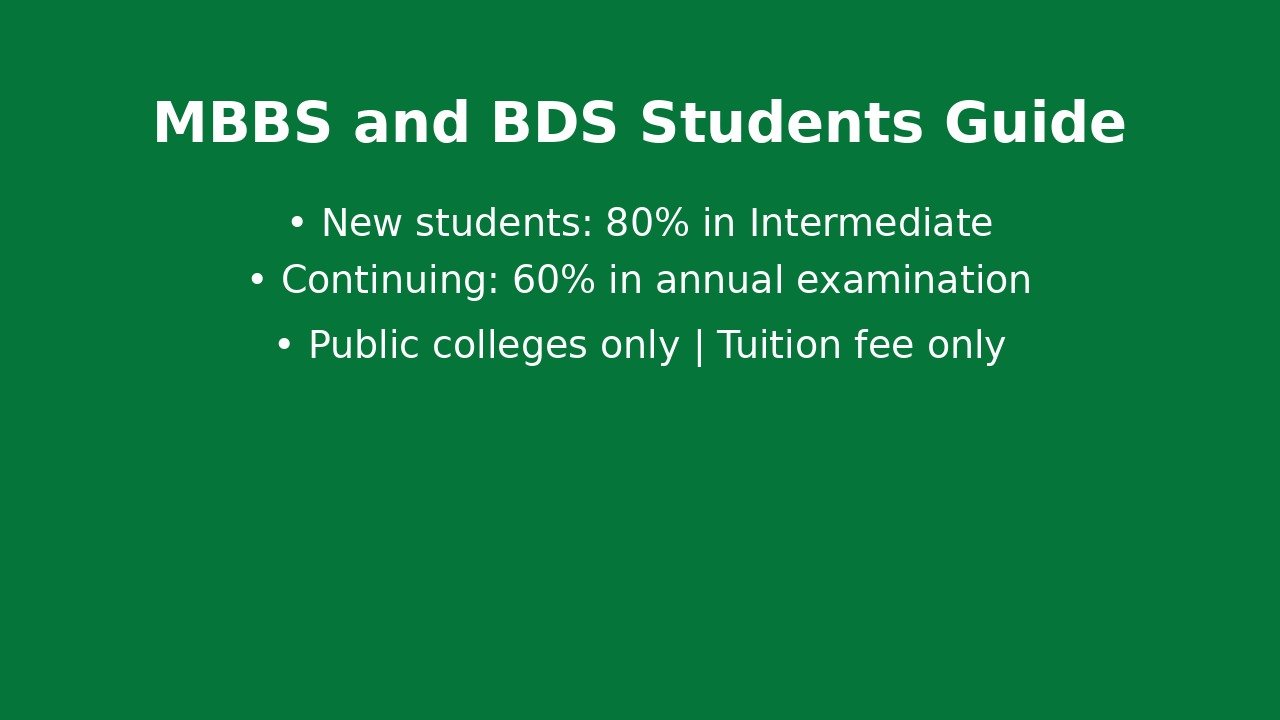
New students: New MBBS and BDS students must have at least 80 percent marks in Intermediate. This is the entry standard for a student beginning the course. Continuing students: Continuing MBBS and BDS students must have at least 60 percent marks in the annual examination. This is the standard for a student who is already enrolled and is being assessed on the annual examination result for continuation.
What to check: Which category you belong to, new or continuing, before you enter marks. What to check: That the marks entered match the official result record exactly. What to check: That the result used is the Intermediate result for a new student, or the annual examination result for a continuing student, as the case may be. Entering a different examination result, or a rounded figure that does not match the record, can create a mismatch during verification.
Students who are close to the threshold should be especially careful. A mark just below the required percentage does not meet the rule, even if the overall performance is strong. Where a result has not yet been announced, or where a rechecking or supplementary position is unclear, students should ask the focal person how the rule applies to their case, rather than entering an expected or estimated mark.
Punjab Domicile Is Mandatory
Honhaar Scholarship Phase 4 eligibility for MBBS and BDS students requires Punjab domicile, and this condition is mandatory. It is not an optional preference or a tie-breaker. A student who does not hold Punjab domicile does not meet this condition, even if marks, college and income conditions are all satisfied.
Required document: A valid Punjab domicile certificate, as required by the programme and the institution. Common mistake: Uploading a domicile document that is blurred, cropped or incomplete, so that the domicile details cannot be verified. Solution: Upload a clear, full-page copy with all details visible, and check that the name and other details on the domicile match the application form and the other documents.
Students should also check that the domicile document they upload is their own, current and genuine document. A domicile belonging to another person, an expired or superseded document where a current one is required, or an edited copy will not pass verification and can lead to rejection. If a domicile document contains an error, the correction must come through the issuing authority, not through editing the uploaded file.
Family Income Limit and the Income Affidavit
Honhaar Scholarship Phase 4 MBBS and BDS students in the public sector must come from families with income under Rs 350,000 per month. This is the income limit that applies to public-sector students under this guide. Students should not assume a different limit, and should not enter an income figure that cannot be supported by genuine family income records.
Income limit: Family income under Rs 350,000 per month for public-sector students. Income proof: An income affidavit on an e-stamp of at least Rs 50. Consistency rule: The income figure on the affidavit must agree with the figure entered in the application form. A mismatch between the two is a common reason for rejection, even when the income itself is within the limit.
Affidavit format: Confirm the required format with the institution focal person before preparing the affidavit, and do not reuse an affidavit from a different scheme without checking that it still meets the format. Affidavit completeness: Complete every required field, check the attestation requirement, and upload a clear, full-page copy. An affidavit with missing signatures, missing details or an unreadable scan can be rejected even if the income figure is correct.
Honesty about income is essential. Understating income to appear eligible, or overstating it by mistake, both create problems during verification. The correct figure is the genuine family income, entered consistently in the form and on the affidavit, and supported by the affidavit as required.
What the Scholarship Covers: Tuition Fee Only
Honhaar Scholarship Phase 4 support for MBBS and BDS students covers tuition fee only. This is a clear and important limit, and students should plan their finances with it in mind from the start. The scholarship does not pay for boarding, lodging, transport or books, and students should not budget as if those costs were covered.
Covered: Tuition fee, as per programme rules. Not covered: Boarding costs. Not covered: Lodging costs. Not covered: Transport costs. Not covered: Books and other study materials. Hostel, travel and book expenses therefore remain the student’s own responsibility, unless covered separately by a different scheme, which should be declared honestly if it is a government fee waiver or scholarship that affects eligibility.
This tuition-only rule also helps students understand what to expect after selection. The benefit is valuable, because medical and dental tuition is a major cost over a long course, but it is not a full living-cost scholarship. Planning for hostel, food, travel and books separately, and seeking only genuine and separately eligible support for those costs, is the realistic approach.
Continuation Rules: Keeping the Scholarship
Honhaar Scholarship Phase 4 continuation depends on continued academic performance and continued eligibility. For MBBS and BDS students, the key academic continuation standard is at least 60 percent marks in the annual examination. A continuing student who falls below that standard in the annual examination does not meet the continuation rule for that stage, and should ask the focal person promptly about the consequence and about any official process that applies, rather than assuming that the benefit continues automatically.
Continuation marks: At least 60 percent in the annual examination for continuing students. Continuation eligibility: Continued study in the same eligible public medical or dental college and course, with continued Punjab domicile and income eligibility as required. Record keeping: Keep each annual result, fee record and programme communication safely, so that continuation can be shown clearly when it is checked.
Students should also inform the institution promptly if their circumstances change in a way that could affect eligibility, such as a change of college, course or domicile position. Hiding a change does not protect the benefit, because verification at a later stage is likely to find it, and a late discovery can be more serious than an early, honest disclosure through the focal person.
Where a continuation rule, date or process has not been announced through official channels, this guide does not invent it. Students should check the portal and ask their institution focal person for the current position for their own year and stage, and should not rely on rumoured dates or procedures from unofficial sources.
Common Mistakes MBBS and BDS Applicants Should Avoid
Honhaar Scholarship Phase 4 MBBS and BDS applications fail most often for avoidable reasons. The first is applying from an ineligible institution type while assuming that all medical colleges are covered. The second is using the wrong marks rule, for example a continuing student entering an Intermediate result instead of the annual examination result, or vice versa. The third is an income affidavit error, such as the wrong stamp, the wrong format or a figure mismatch.
Mistake: Uploading blurred or cropped domicile, result or affidavit documents. Solution: Upload full, clear pages and check them at full size before submitting. Mistake: Saving the form but never submitting it. Solution: Submit the form properly and keep the submission confirmation. Mistake: Creating a second account after a problem. Solution: Use the original account and correct through the institution focal person. Mistake: Sharing documents or passwords with unofficial agents. Solution: Deal only with the official portal and the institution focal person.
A careful final review before submission saves far more time than a correction after rejection. Read the form once more, check every document, confirm the marks rule for your stage, confirm the income figure, and only then submit.
MBBS and BDS Eligibility at a Glance
| Requirement | MBBS and BDS rule | What to check |
|---|---|---|
| Institution | Public medical and dental colleges only | College type from the official enrolment record |
| New students | At least 80% in Intermediate | Intermediate result matches the form exactly |
| Continuing students | At least 60% in the annual examination | Annual examination result, not an earlier result |
| Domicile | Punjab domicile mandatory | Clear, full-page domicile copy with matching details |
| Family income | Under Rs 350,000 per month for public sector; affidavit on e-stamp of at least Rs 50 | One consistent, truthful figure on form and affidavit |
| Coverage | Tuition fee only; no boarding, lodging, transport or books | Plan separately for living costs and study materials |
| Official portal | Use only the official portal for application information | Official portal |

Also Read:
Honhaar Scholarship Merit List Phase 4 2026: How to Check and Selection Process
Honhaar Scholarship Phase 4 2026: Continuing Students Guide (2nd Semester Onward)
Honhaar Scholarship Phase 4 2026: Documents, Application Status and Correction Guide
Honhaar Scholarship Eligibility Criteria Phase 4 2026
Conclusion
For MBBS and BDS students, the Honhaar Scholarship Phase 4 route is clear when each rule is checked in turn. Study in a public medical or dental college, meet the marks rule for your stage, with at least 80 percent in Intermediate for new students and at least 60 percent in the annual examination for continuing students, hold Punjab domicile, and come from a family with income under Rs 350,000 per month in the public sector, proved by an affidavit on an e-stamp of at least Rs 50. The benefit covers tuition fee only, not boarding, lodging, transport or books, and continuation depends on maintaining the annual examination standard and continued eligibility. Students who check these points, upload clear and consistent documents, submit rather than merely save the form, and correct any problem through their institution focal person give themselves the best chance of a smooth application.
Frequently Asked Questions
Are MBBS and BDS students eligible for Honhaar Scholarship Phase 4?
Yes, MBBS and BDS students in public medical and dental colleges can be eligible, provided they meet the marks, domicile and income rules in this guide.
What marks do new MBBS and BDS students need?
New students need at least 80 percent marks in Intermediate.
What marks do continuing MBBS and BDS students need?
Continuing students need at least 60 percent marks in the annual examination.
Is Punjab domicile required for MBBS and BDS applicants?
Yes. Punjab domicile is mandatory for MBBS and BDS applicants under this guide.
What does the scholarship pay for?
It covers tuition fee only. It does not cover boarding, lodging, transport or books.
What income affidavit is required?
Family income must be under Rs 350,000 per month for public-sector students, with an income affidavit on an e-stamp of at least Rs 50.

Shahzad Sahil is the editor of 10thclassresultcheck.pk, covering 10th class results for BISE boards across Pakistan, with information verified from official board sources for students.
Latest Articles