For many applicants, the Honhaar Scholarship Income Affidavit Phase 4 2026 is the document that causes the most confusion. Marks are clear, domicile is clear, but family income has to be stated honestly, proved in a prescribed format, and matched to the right limit for your institution type. Get it wrong, and an otherwise strong application can be delayed or rejected. This article explains the limits, the affidavit, and the common mistakes, using only portal-verified rules.
The basic idea is simple. This scholarship combines merit with financial need. It is meant for students whose families cannot easily afford tuition fees. Family income is therefore not a formality. It is a central eligibility condition, and the portal requires an affidavit as proof. The affidavit must be prepared honestly, in the prescribed format, and uploaded in a clear, legible form.
Income Limits by Institution Type
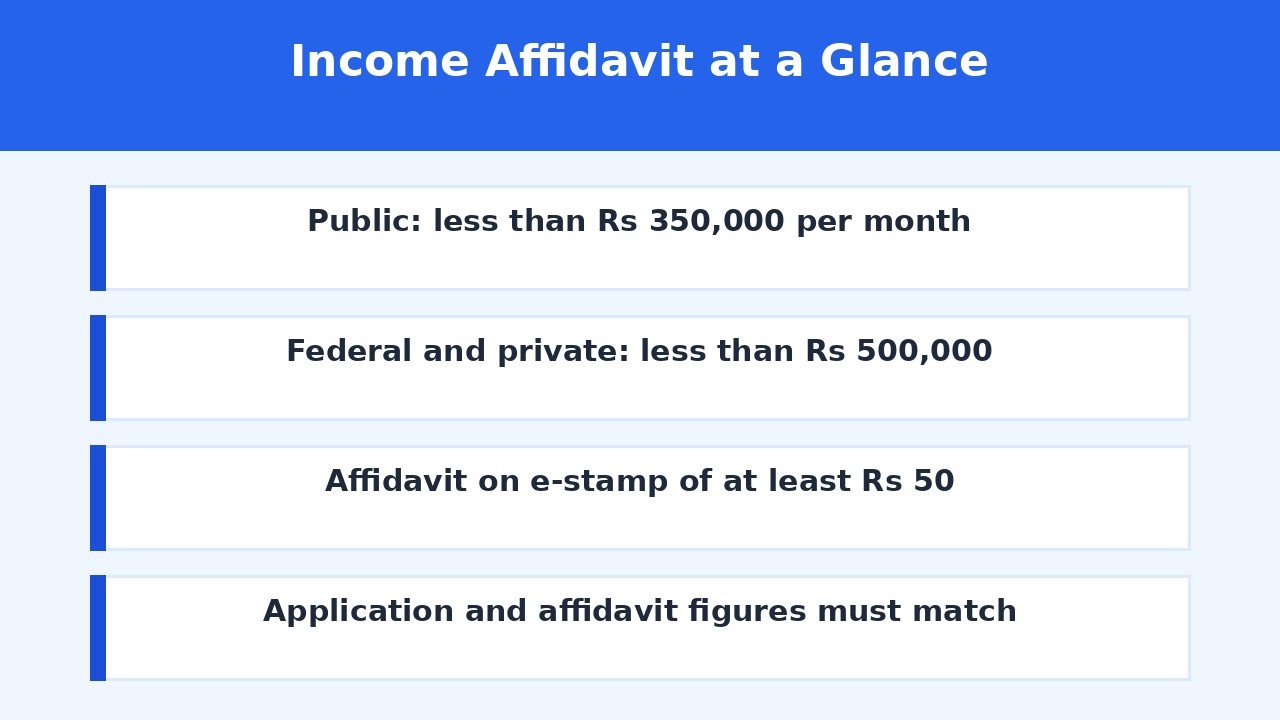
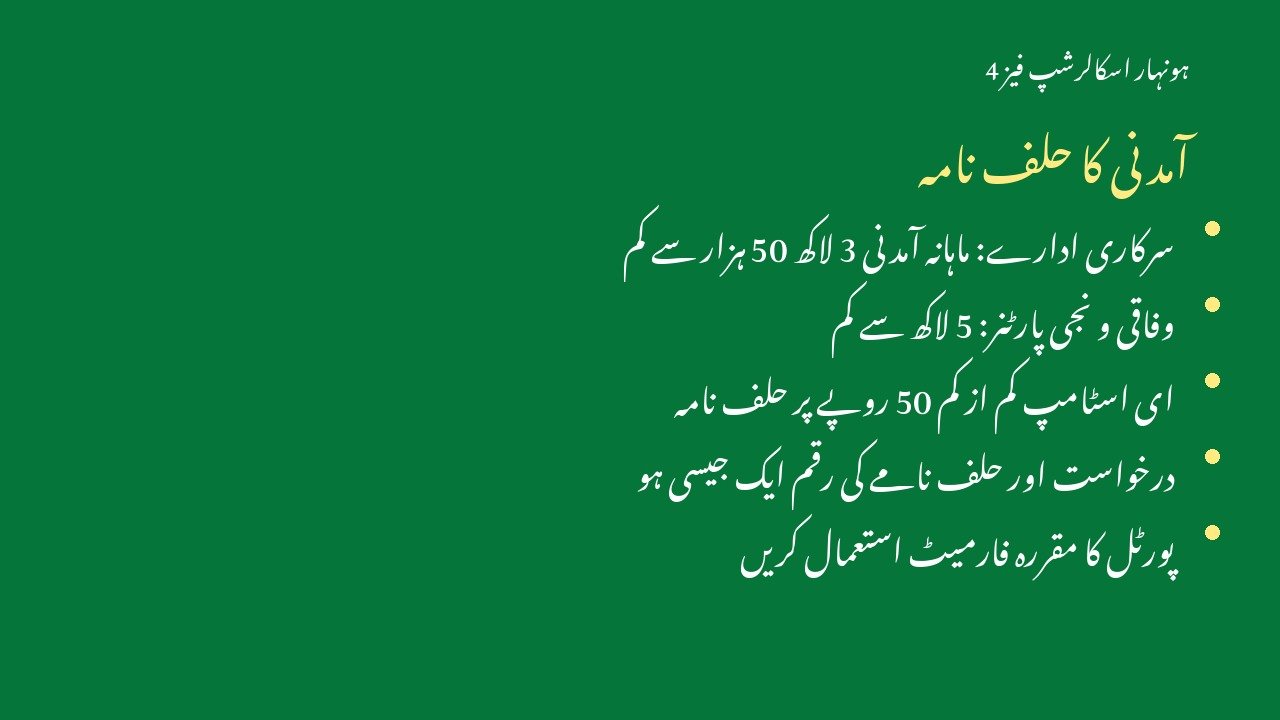
There are two monthly family income limits, and using the wrong one is a common error. For public sector higher education institutions, family monthly income must be less than Rs 350,000. For partner federal and private sector institutions, the limit is less than Rs 500,000 per month. These are monthly limits, not annual limits, and not scholarship amounts.
Public sector limit: less than Rs 350,000 per month. This applies to new admissions at public universities and related public institutions, and to continuing students at eligible public institutions.
Federal and private limit: less than Rs 500,000 per month. This applies only to new Fall 2026 admissions at selected federal or private partner institutions. It cannot be used by a public institution applicant whose income is above Rs 350,000, and it cannot be applied to continuing students at private institutions, because that continuing category is limited to the public sector.
| Applicant Category | Monthly Family Income Limit |
|---|---|
| New admission, public institution | Less than Rs 350,000 |
| Continuing student, eligible public institution | Less than Rs 350,000 |
| New Fall 2026 admission, selected federal or private partner | Less than Rs 500,000 |
| What the limit is not | Not an annual figure, and not the scholarship amount |
| Official portal | honhaarscholarship.punjabhec.gov.pk |
Also Read: Honhaar Scholarship Phase 4 2026: Eligible Universities and 70 Disciplines List
What the Affidavit Must Show
The Honhaar Scholarship Income Affidavit Phase 4 2026 is a sworn statement of family income, prepared on e-stamp paper of at least Rs 50. The portal provides a prescribed template and a sample affidavit for download. Use that template, rather than a general affidavit format copied from elsewhere, and check the exact format on the portal for your category before you prepare it.
Honest figures: enter the family income figure in the application exactly as it is supported by the affidavit. If the application figure and the affidavit figure do not match, verification can fail. Do not understate income to fit under a limit, and do not overstate it by mistake. Both errors create the same problem: the record does not match.
Who counts as family: follow the portal definition and the template wording for your case, and ask your focal person if your family situation is unusual, for example if parents live separately or if income comes from more than one source. Do not guess at a definition that the portal has not given.
Other support check: an applicant who is already receiving a fee waiver or financial assistance from another government agency, department, institute, university, or college is not eligible, and the scholarship cannot be combined with another government or private scholarship covering tuition fees. If you already receive such support, confirm your specific situation with the portal or your focal person before giving up an existing scholarship or submitting a new application.
Also Read: Honhaar Scholarship Phase 4 2026: Documents, Application Status and Correction Guide
How to Prepare and Upload It
Step 1: download the prescribed affidavit template or sample from the official portal, and read it fully before filling it in.
Step 2: prepare the affidavit on e-stamp paper of at least Rs 50, with the income details, names, and declarations exactly as the template requires.
Step 3: check every name and figure against your other documents. Names should be spelled the same way across documents, and the income figure should match the figure entered in the application.
Step 4: scan or photograph the affidavit clearly. Every page should be legible, with no cut-off edges, shadows, or blurred text. After uploading, check that the file has actually attached and that any preview shown by the portal is readable.
Step 5: submit only after rechecking the whole form. Saving the form without formal submission is not proof of application, and the confirmed deadline is 9 November 2026.
Download Affidavit Format — Official Portal
Also Read: Honhaar Scholarship Phase 4 2026: Continuing Students Guide (2nd Semester Onward)
Common Mistakes That Cause Rejection
Wrong limit used: a public institution applicant applies the Rs 500,000 limit, or a federal or private applicant assumes the limit applies to a continuing year. Use the table that matches your own institution and category.
Figure mismatch: the application says one income figure and the affidavit says another. Verification treats a mismatch as a problem, even if both figures are below the limit.
Wrong stamp or format: an affidavit on a lower stamp value, or in a format different from the prescribed template, can be questioned. The minimum is at least Rs 50 on e-stamp paper, and the template is the safest guide.
Unclear upload: a blurred, cropped, or incomplete scan is treated as an incomplete document. Re-upload a clear copy before submission, not after, if the portal allows it.
Hidden other support: failing to disclose an existing fee waiver or scholarship can lead to rejection when verification finds it. Disclosure and a focal person check are safer than silence.
Also Read: Honhaar Scholarship Merit List Phase 4 2026: How to Check and Selection Process
Conclusion
The Honhaar Scholarship Income Affidavit Phase 4 2026 is straightforward if it is handled in order: use the right limit for your institution, use the portal template on e-stamp paper of at least Rs 50, make the application figure and the affidavit figure match, and upload a clear copy. Most income-related rejections come not from income itself, but from a wrong limit, a mismatched figure, or an unclear document. Prepare the affidavit early, check it against your other documents, and submit before 9 November 2026, so that a small error can still be corrected in time.
Frequently Asked Questions
What is the income limit for public institutions?
Family monthly income must be less than Rs 350,000 for public sector institutions.
What is the income limit for federal and private partners?
For new Fall 2026 admissions at selected federal or private partners, it is less than Rs 500,000 per month.
What stamp value is required for the affidavit?
The affidavit must be on e-stamp paper of at least Rs 50, in the prescribed format.
Can I use a general affidavit format?
No. Use the prescribed template and sample available through the official portal.
What if my application income and affidavit income differ?
That mismatch can cause verification problems. Make both figures match before submission.
Is there an application fee?
No. There is no application fee for this scholarship.

Shahzad Sahil is the editor of 10thclassresultcheck.pk, covering 10th class results for BISE boards across Pakistan, with information verified from official board sources for students.
Latest Articles