Fuel prices affect daily travel, especially for motorcycle and small-vehicle users. The 9771 Fuel Relief Scheme 2026 has been discussed as relief for eligible non-commercial users, at a reported Rs100 per litre. This guide explains what is reported, who may benefit, and what to verify before sharing details.
First, the key warning: confirm the exact SMS format and current operational status through an official government notice before sending personal information. Do not act on a forwarded message or unofficial claim alone.
What the Scheme Is Reported to Offer
Under the reported structure, relief applies to a limited quantity of fuel each month, not unlimited fuel. The reported rate is Rs100 per litre.
- Reported rate: Rs100 relief per litre for eligible users.
- Monthly limit: Relief applies only up to the stated litre cap.
- Target users: Eligible non-commercial users, not commercial fleets.
- One-vehicle limit: One vehicle per user or owner, reportedly.
Reported Monthly Relief by Vehicle Category
| Vehicle Category | Monthly Limit | Max. Relief |
|---|---|---|
| Motorcycles | 20 litres | Rs2,000 |
| Three-wheelers | 20 litres | Rs2,000 |
| Vehicles up to 800cc | 30 litres | Rs3,000 |
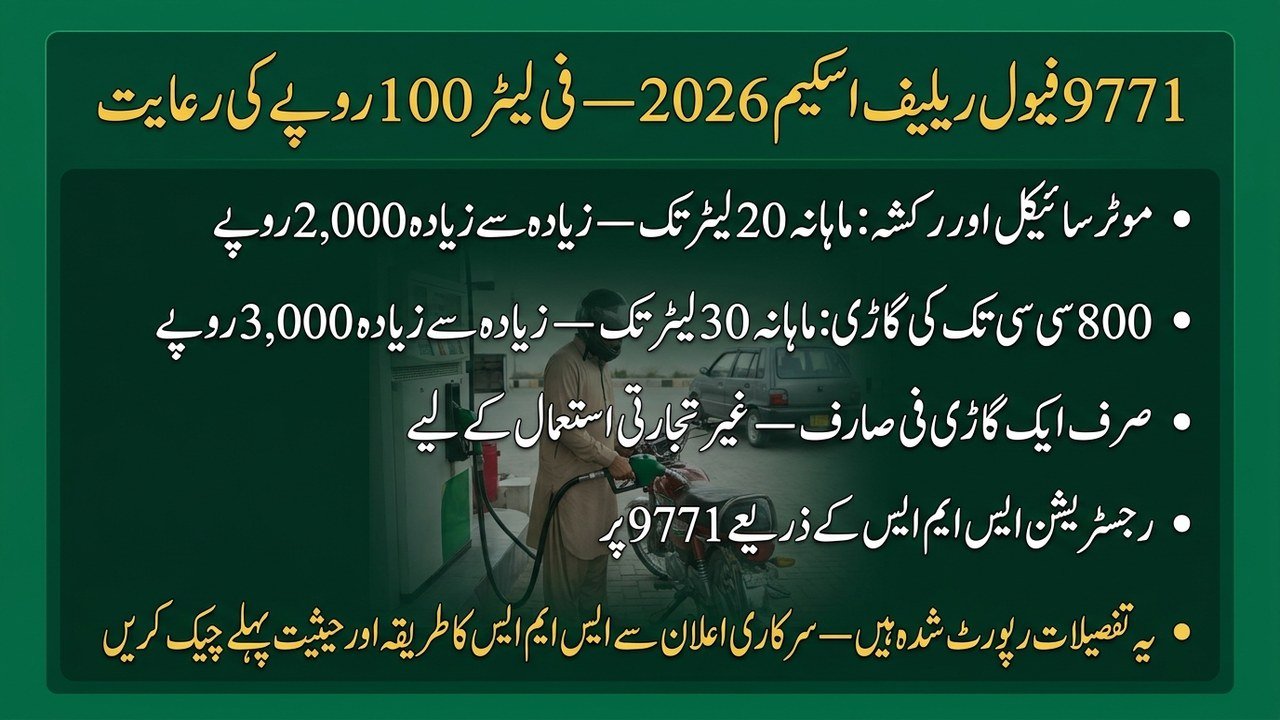
Eligible three-wheelers include rickshaws and Qingqi vehicles. At Rs100 per litre, 20 litres gives up to Rs2,000 monthly, and 30 litres gives up to Rs3,000. Less fuel means lower relief.
Who May Be Eligible
Eligibility is reported only in broad terms; the official notice will be the final test. The intended group appears to be:
- Non-commercial users: Ordinary private travel is the reported focus.
- Motorcycle users: Included in the reported description.
- Three-wheeler users: Eligible rickshaw and Qingqi users are included.
- Small vehicles: Eligible vehicles up to 800cc are included.
- One vehicle only: One vehicle per user or owner, reportedly.
Engine capacity matters: above 800cc is outside this category, and a second vehicle creates no second entitlement.
Registration: What Must Be Verified First
Registration is described as SMS-based via 9771, but no step-by-step SMS format is presented here as confirmed fact. Confirm the exact format and current status through an official government notice before sending personal information.
Until an official notice is available, treat any SMS format from social media, forwarded messages, or unknown callers as unverified. A genuine programme would be announced officially, with clear instructions. If those details are missing, pause.
- Official notice first: Confirm the scheme, SMS format, and current status officially.
- Unverified messages: Do not follow SMS instructions from forwarded messages or unknown numbers.
- Personal details: Do not send identity or vehicle details until the channel is verified.
- Confirmation record: Keep any verified-channel reference safe.
Details to Keep Ready
While verification is pending, keep the basic record ready. This does not authorise sharing details with an unverified number.
- National identity card: Keep CNIC details ready for a verified check only.
- Vehicle registration: Keep the registration record for the vehicle to be registered.
- Engine capacity: Note the engine capacity, since the small-vehicle limit is up to 800cc.
- Mobile number: Use your own accessible mobile number.
- Confirmation reference: Save any verified-channel reference.
Reported Figures That Need Careful Reading
Some large figures have been reported for this scheme. A reported figure is not a confirmed official announcement.
- Registrations figure: More than 125 million registrations is reported and has not been independently confirmed by an official announcement, so treat it as reported, not verified.
- Allocation figure: The Economic Coordination Committee’s reported Rs75 billion allocation is also reported, not confirmed disbursement, and should not be read as money already paid out.
- Duration claim: A PM announcement quoted in the source says the subsidy will continue till December 2026, also as reported.
Large numbers can mislead: a registration count does not prove validity or receipt, and an allocation is not the same as disbursement.
Safety Rules: Protect Yourself From Fraud
Relief schemes attract fake messages. Follow these rules for this scheme and any similar offer.
- Never share sensitive details: Never send CNIC or vehicle details to unverified numbers.
- Never pay in advance: Never pay advance fees to release a subsidy.
- Never share passwords or PINs: Never share passwords or PINs with anyone claiming to process relief.
- Check the sender: Treat unknown callers as warning signs.
- Stop if pressured: If someone pressures you to act at once, stop and verify officially.
A genuine programme asks for no fee to unlock a subsidy, and no password or PIN. Treat any urgent payment demand as suspicious, and do not reply with personal details.
How to Use This Information Wisely
Up to Rs2,000 monthly for a motorcycle user, or up to Rs3,000 for a small-vehicle user, is a meaningful saving — but these are maximums under the reported caps, not a fixed payment for all. Confirm the scheme is operational, you meet official conditions, and the channel is verified. Rules can change, so check the latest official notice before acting.
Conclusion
The Fuel Relief Scheme is reported to offer Rs100 per litre to eligible non-commercial users: up to 20 litres monthly for motorcycles and eligible three-wheelers, and up to 30 litres for vehicles up to 800cc, with one vehicle per user or owner. That is up to Rs2,000 and Rs3,000 monthly respectively. Before acting, confirm the SMS format and status officially, treat large reported figures with caution, and never share sensitive details or pay fees to unverified contacts.
Frequently Asked Questions
What is the reported relief per litre?
Rs100 per litre for eligible users, subject to the monthly limits above.
How much can a motorcycle user receive monthly?
Up to 20 litres monthly, a maximum of Rs2,000, under the reported limits.
How much can a small-vehicle user receive monthly?
Up to 30 litres for an eligible vehicle up to 800cc, a maximum of Rs3,000 monthly.
Can one person register more than one vehicle?
No. Under the reported rule, one vehicle per eligible user or owner only.
Should I send my CNIC details by SMS at once?
No. Confirm the SMS format and status officially first, and never send CNIC or vehicle details to an unverified number.

Shahzad Sahil is the editor of 10thclassresultcheck.pk, covering 10th class results for BISE boards across Pakistan, with information verified from official board sources for students.
Latest Articles